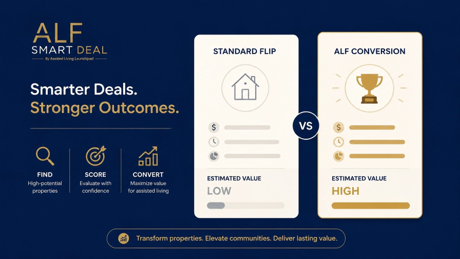
Standard residential flipping is a red ocean. Too many investors chasing the same distressed inventory. Too many amateurs bidding up prices until margins vanish. You fix a kitchen, you paint a wall, and you pray the neighborhood comps haven't shifted by the time you list.
It's a transactional treadmill. You're only as good as your next buy.
But there is a different game. One played with business logic, not just real estate comps. It's the ALF conversion. By shifting a property from a single-family home to a licensed residential assisted living facility, you aren't just selling a house. You're selling a stabilized, cash-flowing business asset.
Here is the raw math, the strategic moat, and the logic for why an ALF conversion destroys a traditional fix 'n flip every time.
1. Valuation: Income Approach vs. Sales Comparison
In a standard flip, you are a slave to the "comps." If the house next door sold for $500k, your ceiling is effectively capped. No amount of "luxury vinyl plank" will break the gravity of the neighborhood median.
Assisted living is different. Once a property is licensed and occupied, it transitions from a "residential asset" to a "commercial business asset."
The math:
- Fix 'n Flip: Value = Recent Sales of Similar Houses.
- ALF Conversion: Value = Net Operating Income (NOI) ÷ Cap Rate.
If your facility in Maryland or Virginia generates $150,000 in NOI and the market cap rate for small ALFs is 10%, that property is worth $1.5M. It doesn't matter if the house next door sold for $600k. Your value is dictated by the revenue generated by the licensed beds, not the granite in the kitchen.
You are creating equity through operational excellence, not just cosmetic updates.
2. The Triple Threat Exit: Flexibility is Your Hedge
Most flips have one exit: Sell. If the market dips or interest rates spike, you're stuck with a high-interest bridge loan and a property that won't move.
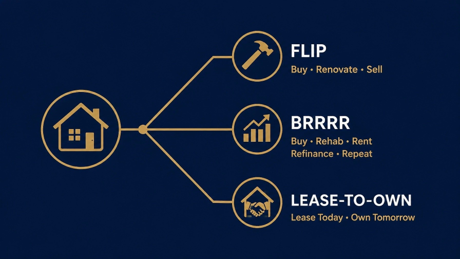
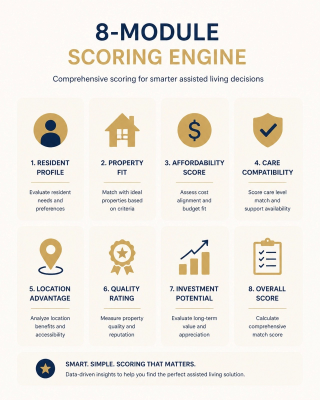
At ALF Smart Deal, we don't just look at the flip. Our 8-module scoring engine models three distinct strategies simultaneously:
Strategy A: The Flip
Sell the property post-conversion to an operator who wants a turnkey facility. You capture the spread between residential purchase and commercial valuation.
Strategy B: The BRRRR (Buy, Rehab, Rent, Refinance, Repeat)
Refinance based on the new income-based valuation. Pull your initial capital out — plus profit — and keep the property as a high-yield rental. Standard residential rentals might yield 5–7% cash-on-cash. A stabilized ALF can easily hit 20%+.
Strategy C: The Lease-to-Own (LTO)
This is the specialized winner for ALF. You find a qualified operator who wants to own their own facility but lacks the immediate down payment. You lease the property to them at a premium, with a built-in purchase agreement in 24–36 months. You get high monthly cash flow and a guaranteed exit price.
3. Recession Resilience and the "Silver Tsunami"
Residential real estate is volatile. It's tied to consumer confidence, employment rates, and the whims of the Fed.
Senior housing is tied to biology.
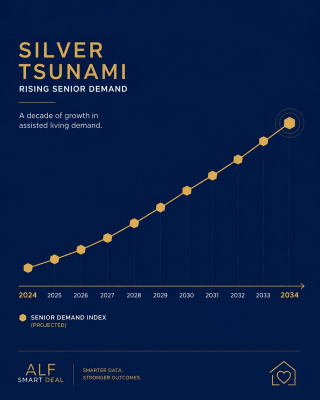
The "Silver Tsunami" is not a marketing term; it is a demographic reality. 10,000 Baby Boomers turn 65 every single day. By 2030, all Boomers will be older than 65. In states like Maryland and Virginia, the inventory of quality residential assisted living is nowhere near meeting the projected demand.
When the economy slows down, people stop buying "starter homes." They do not, however, stop needing care for their aging parents. This demand creates a floor for your investment that residential flips simply cannot match. You are investing in a necessity, not a commodity.
4. ROI: The Bed-Count Math
In a standard flip, adding a bedroom might add $20k to the ARV. In an ALF conversion, adding a bedroom — or optimizing the floor plan for more licensed beds — changes the entire financial profile of the deal.
In Maryland, for example, navigating licensing levels (Type A, B, or C) and bed-count regulations is where the real money is made. If you can take a 5-bedroom home and legally license it for 8 or 10 beds through smart infrastructure screening, your revenue potential scales exponentially without adding to your acquisition cost.
- Standard Flip ROI: Typically 15–20% on a project basis.
- ALF Conversion ROI: Often 25–40%+ cash-on-cash, with massive "embedded equity" once the facility is stabilized and valued at a 10% cap rate.
5. Data Over Gut: The 12-Minute De-risk
The biggest barrier to ALF conversions is complexity. Zoning, fire codes, jurisdictional licensing, and bed-count math are enough to scare off most residential flippers.
That's your moat. Complexity keeps the competition low.
The way to win is to stop guessing. We built the ALF Smart Deal platform to solve this. Instead of spending weeks talking to architects and licensing consultants, our engine provides a sample-ready deal memo in 12 minutes.
We screen the infrastructure, check the jurisdictional licensing in Maryland or Virginia, and run the financial modeling for all three exit strategies. You get a defensible, lender-ready report that tells you the math, the moat, and the logic of the deal before you ever sign a contract.
The Verdict: Stop Flipping, Start Scaling
If you want to keep chasing $50k spreads in a crowded market, stay with the residential flip. It's familiar. It's also increasingly difficult to scale.
If you want to build a portfolio of high-value, recession-resilient assets that are valued like businesses, look at ALF conversions. The demand is guaranteed. The valuation is superior. The exits are more flexible.
The only thing missing is the data to make the move.
Ready to stop flipping and start scaling? Send one property you are considering to our team, and we'll score it for free.
Let the math do the talking.